
Cloud cost control is an operating model, not a monthly clean-up exercise. Ongoing FinOps support helps organisations understand, manage and optimise technology costs. Its operating model brings together four domains: Understand Usage & Cost, Optimise Usage & Cost, Quantify Business Value, and Manage the FinOps Practice.
Clear visibility matters, but it does not determine who acts on cost insights or how decisions support business priorities. IT FinOps as a Service can structure that work through documented processes, clear responsibilities and expectations aligned with how technology resources are used.
This article explains what the service does, how its processes connect finance, technology and business teams, and what influences cost expectations. It also explores the four domains and how they can fit into an organisation’s operating model.
Key Takeaways
- Set clear ownership across finance, technology and business teams so cost insights lead to accountable decisions.
- Document how teams handle allocation, forecasting, budgeting and reporting to make FinOps processes consistent.
- Shape cost expectations around usage, organisational priorities and the scope of ongoing support rather than assuming a standard fee.
- Connect resource decisions to business value, while factoring security and managed risk exposure into governance.
- Use the operating model to identify where independent governance and commercial optimisation can strengthen financial control.
What is FinOps as a Service?
IT FinOps as a Service applies financial management practices to technology spending. It helps organisations understand, allocate and manage costs, linking resource use, financial reporting and business decisions rather than treating each invoice as an isolated event.
Outsourced cloud cost management
FinOps as a Service combines specialist guidance with ongoing work to manage cloud costs. It can help when internal teams need clearer cost ownership or consistent optimisation without building every capability themselves. Pricing depends on scope and is provided after a quote request. Compare it with in-house teams or consultants by considering staffing, expertise, service duration and responsibility. Outsourcing also has limits: unclear ownership, poor usage data or restricted access can weaken analysis, so internal teams still need to approve decisions and remain accountable.
Cloud-native tools and service options
FinOps tools may be cloud-native, third-party, built internally or integrated with existing financial systems. Cloud providers, resellers and managed service providers can each support cost reporting, but their roles differ: a provider supplies its own usage data, a reseller may consolidate commercial information, and an independent service can help align reporting across platforms. Organisations can track compute, storage, SaaS, AI, licensing and data-centre costs. For example, usage across AWS, Microsoft Azure and Google Cloud can be considered alongside other technology costs where integrations support it.
Scaling across teams and environments
Scaling FinOps means establishing repeatable allocation, reporting and decision-making processes across teams and technology environments. A shared cost structure lets finance compare departmental spending, while engineering teams investigate the resource choices behind it. Assign cost owners and consistent categories, then extend reporting across platforms and business units. Set reporting frequency to suit stakeholder needs. Integrations should fit existing tools and workflows, so a new platform supports adoption rather than creating a separate process.
Governance and business value
Financial governance links technology usage to budgets, business outcomes and accountable decisions. The FinOps Framework, associated with the FinOps Foundation, groups practice into four domains: Understand Usage & Cost, Optimise Usage & Cost, Quantify Business Value, and Manage the FinOps Practice. For South African organisations, privacy considerations under POPIA, data residency and security should inform what information a service accesses, where it is processed, who can view it and how access is governed. Apply these considerations alongside internal policies, contractual duties and organisational objectives. A service can support cloud providers and teams, but internal decision rights and approvals remain important. Connect cost reporting with resource decisions so commercial optimisation supports business value and managed risk exposure.
Documenting processes and setting cost expectations
Documented processes turn cost data into repeatable decisions, while clear expectations define what teams will monitor and manage. Together, they support consistent allocation, forecasting and accountability across technology spending.
Cost allocation and cost recovery
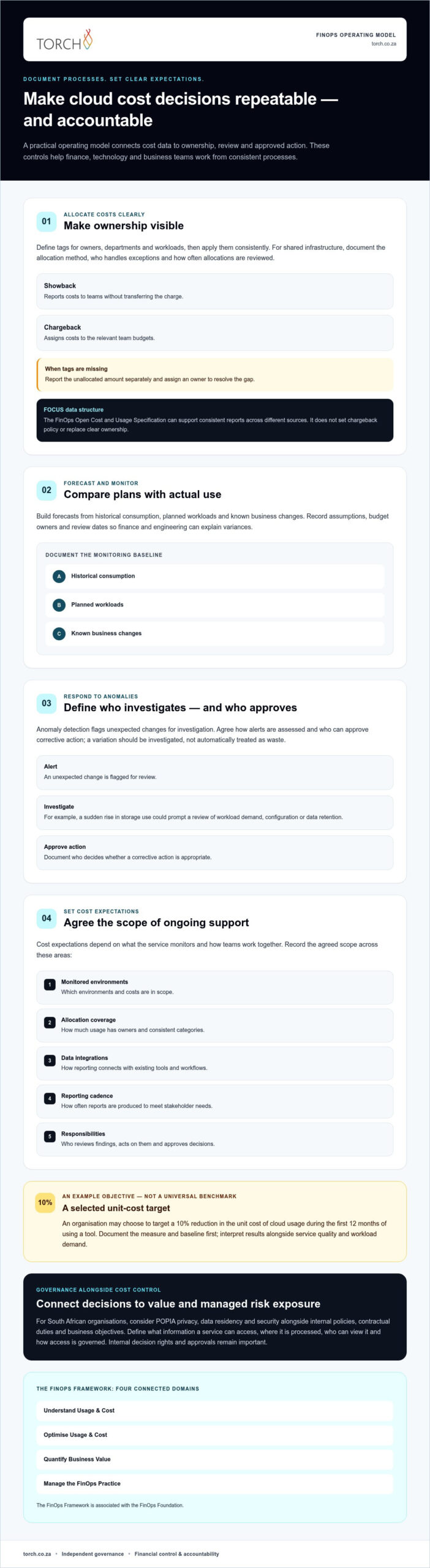
Cost allocation assigns technology usage to the teams or services responsible for it, making spending visible and accountable. Start by defining a tagging structure for owners, departments and workloads, then apply it consistently to resources. Showback reports costs to teams without transferring the charge; chargeback assigns those costs to their budgets.
Shared infrastructure needs an agreed allocation method, such as dividing a service’s costs by measured usage or an approved departmental proportion. Document how the method works, who owns exceptions and how often allocations are reviewed. This prevents teams from treating shared costs as unowned overhead. Where tags are missing, report the unallocated amount separately and assign an owner to resolve the gap.
FinOps Open Cost and Usage Specification (FOCUS) provides a common structure for cloud cost and usage data. It can help organisations compare information from different sources in consistent reports, while tags and allocation rules identify who is responsible. FOCUS supports data consistency; it does not set an organisation’s chargeback policy or replace clear ownership.
Forecasting and cost monitoring
Forecasting estimates future usage and spending, while monitoring compares actual costs with budgets and expected patterns. Establish a baseline from historical consumption, planned workloads and known business changes. Then record assumptions, budget owners and review dates, so finance and engineering can explain differences rather than simply report them.
Anomaly detection flags unexpected changes for investigation. For example, a sudden rise in storage use could prompt a review of workload demand, configuration or data retention. Define who receives alerts, how they assess the cause and who can approve a corrective action. This creates a practical response process without treating every variation as waste.
Organisations may set a target of reducing the unit cost of cloud usage by 10% during the first 12 months of using a tool. Treat this as a selected objective, not a universal benchmark: unit cost, service quality and workload demand all affect interpretation. Document the measure and its baseline before tracking progress.
Set cost expectations around the monitored environments, allocation coverage, data integrations, reporting cadence and agreed responsibilities. A useful FinOps Framework process records how teams use tools, who acts on findings and how decisions are escalated. To discuss how these controls could fit your operating model, arrange a FinOps governance review.
FinOps teams prioritise allocation, forecasting and budgeting, planning and estimating, reporting and analytics, and data ingestion across SaaS, data-centre, AI and licensing costs. Cloud FinOps uses allocation and chargeback to distribute costs across departments and promote accountability. Document the tools and services involved, the use cases and how teams will be onboarded.
FinOps as a Service definition and purpose
IT FinOps as a Service brings ongoing specialist guidance to managing technology spending. Its purpose is to develop practices and capabilities that connect resource use with financial decisions.
The purpose of FinOps as a Service
An external FinOps service helps an organisation develop its ability to identify spending patterns and act on them. It can provide expert guidance, training, consulting or managed support, according to the capabilities required. This can be useful when technology environments expand faster than internal cost-management practices, leaving teams without clear insight into the financial effects of their technical choices.
The engagement is ongoing, rather than a one-off review. A service can help identify inefficiencies and recommend optimisation, then support teams as their needs evolve. For example, an organisation might first establish cost visibility for a technology environment, then extend its practices to other teams. The service’s value depends on connecting findings to decisions, not simply producing another report.
Specialists can help finance and engineering teams discuss the same resource in practical terms. A technology workload has a usage pattern, an allocated cost and a business purpose. Linking these elements helps teams assess whether spending supports the intended outcome. It also clarifies where technical changes need financial review, and where budget decisions require context from the people responsible for workloads.
FinOps tools and service definitions
A FinOps tool is software that supports one or more FinOps capabilities; a FinOps service provides expert guidance through activities such as training, consulting or managed support. The distinction matters because software can surface information, while people establish practices and help teams interpret it. A service may use tools, but a tool alone does not assign ownership or determine how an organisation should act.
For example, an integrated tool can draw usage and cost information from cloud providers and financial systems. A service team can then help structure that information into reporting that supports decisions. Costs can be tracked against measurable resources, such as compute or storage, giving teams a clearer view of each unit’s financial impact. The relevant measures depend on the organisation’s objectives and how its teams use the data.
Automation and AI may assist with identifying cost-saving opportunities, forecasting future usage or adjusting resources to demand. Analytics can also highlight underused resources for review. These capabilities require governance: teams need defined approval practices for automated changes, budget alerts and resource policies. A service can help establish those controls, explain findings and transfer knowledge to internal champions, so the organisation develops expertise alongside external support.
FinOps operating model and core domains
A FinOps operating model defines how teams make decisions about technology costs, responsibilities and business value. Implementation starts by agreeing objectives, assigning owners, connecting cost data, and reviewing results with finance and engineering.
The FinOps Framework, associated with the FinOps Foundation, organises the practice into four domains. Together, they connect cloud operations to accountable decisions rather than treating savings as the sole measure of success.
- Understand Usage & Cost: establish how workloads consume resources and where costs sit. For example, connect a cloud service’s usage to its team, application and business purpose.
- Optimise Usage & Cost: assess whether resources match workload needs. Engineering teams can review idle capacity or inefficient configurations, then weigh changes against performance and security requirements.
- Quantify Business Value: relate technology spending to outcomes such as service delivery, resilience or product performance. A cost change is meaningful when decision-makers can see its operational effect.
- Manage the FinOps Practice: set roles, processes and measures for ongoing governance. Finance, engineering and business leaders need clear routes to review forecasts, approve actions and resolve competing priorities.
The operating structure affects how those domains work in practice. 78% of FinOps teams report to the CTO or CIO organisation, whilst 60% use a centralised enablement model and 21% use a hub-and-spoke model. A central team can set common methods; embedded practitioners can adapt them to local workloads. The suitable model depends on decision rights, team structure and how consistently costs need to be managed.
For implementation, begin by agreeing the business outcomes and scope. Next, map technology accounts, cost data and decision owners; establish a baseline; then assign responsibilities for reporting and action. Test the model with selected workloads before extending it across teams. This sequence helps reveal gaps in allocation, data quality or approval processes before wider adoption.
Operating measures should reflect both financial and technical outcomes. Track forecast accuracy, resource utilisation, unit costs and the effect of optimisation on workload performance. For example, engineering may propose a change that lowers resource use, while product owners assess its impact on service delivery. A shared review gives finance the context to interpret the figures and helps teams avoid changes that undermine agreed outcomes.
Leadership engagement matters because FinOps decisions can shape technology selection and placement. Include finance, engineering and business representatives in governance discussions, and record who owns each decision. This creates financial control and accountability while keeping the framework aligned with operational priorities.
Torch Services: Telecom Expense Management
Torch Services offers Telecom Expense Management for organisations seeking greater oversight of telecom expenditure, alongside IT FinOps-as-a-Service for technology cost governance. Its track record includes over 20 years in the South African market and R667.5M+ saved since 2004 across 12 African countries.
Turn to Torch Services when spending information is difficult to interpret, ownership is unclear or teams need more structured financial control. Its offering also includes Automated User support and an asset-management service, which can address related operational needs. The right focus depends on the governance priorities and processes your organisation wants to strengthen.
To discuss your requirements, contact Torch Services.
Make the next technology decision more accountable
Every new workload, renewal or platform change can expose a gap between technical priorities and financial oversight. Bring cost ownership into those decisions early, while teams can assess the business case, operational impact and managed risk exposure together.
IT FinOps as a Service can support financial discipline as technology environments and organisational priorities change. Start by identifying an upcoming business decision, then clarify the financial and operational outcomes its owners need to evaluate. This gives the discussion a clear focus and helps connect independent governance with commercial optimisation.
A considered operating model does not need to solve every cost challenge at once. It needs to make the next decision clearer, with responsibilities people can act on and review.
Start with the decision in front of you, and build stronger financial control from there.
Frequently Asked Questions
What’s in the offering?
Torch Services offers IT FinOps-as-a-Service, focused on managing enterprise technology expenditure. The engagement’s scope should align with your organisation’s technology estate and governance priorities, rather than assuming every activity applies equally. For example, a finance director may need stronger oversight of technology budgets, while IT leaders need insight to explain spending decisions. Agree the environments covered, responsibilities and intended outputs at the outset.
What is IT FinOps as a Service?
IT FinOps as a Service is an ongoing managed engagement that applies financial management practices to technology use. Its purpose is to make cost decisions part of routine operations, rather than an occasional finance exercise. For example, after a product team launches a workload, finance and engineering can review its usage, business purpose and budget ownership together. The service supports that discipline; internal leaders retain business decision authority.
What services and deliverables does a FinOps provider offer?
A provider’s deliverables can include a service calendar, cost reports, forecast updates, anomaly reviews and recommendations for accountable teams. A mature engagement should also clarify how findings become decisions: who assesses a variance, who approves a change and how the outcome is recorded. For example, a management report can pair cost movements with named owners and follow-up actions. Training and knowledge transfer help internal teams sustain the practice.
How do you choose an IT FinOps as a Service provider in South Africa?
Assess a South African FinOps service against your technology estate, finance processes and governance expectations. Request a demonstration using a representative reporting scenario, then examine how usage data is integrated, protected and accessed. Clarify service boundaries, escalation routes, decision rights and knowledge transfer to your team. A suitable service should support the platforms and operating practices you use, while keeping internal accountability clear.
What savings and ROI can organisations expect from managed FinOps?
Estimate ROI from a defined baseline, then compare measured changes in unit costs, resource use and operational effort with the engagement’s total cost. Separate verified reductions from avoided future spend, and account for workload growth or service-quality changes before attributing results. Service pricing depends on scope and is provided after a quote request; key cost factors include environments covered, integrations, reporting needs and assigned responsibilities.